AI Is Sending Your Best Customers to Competitors. Here's Why:

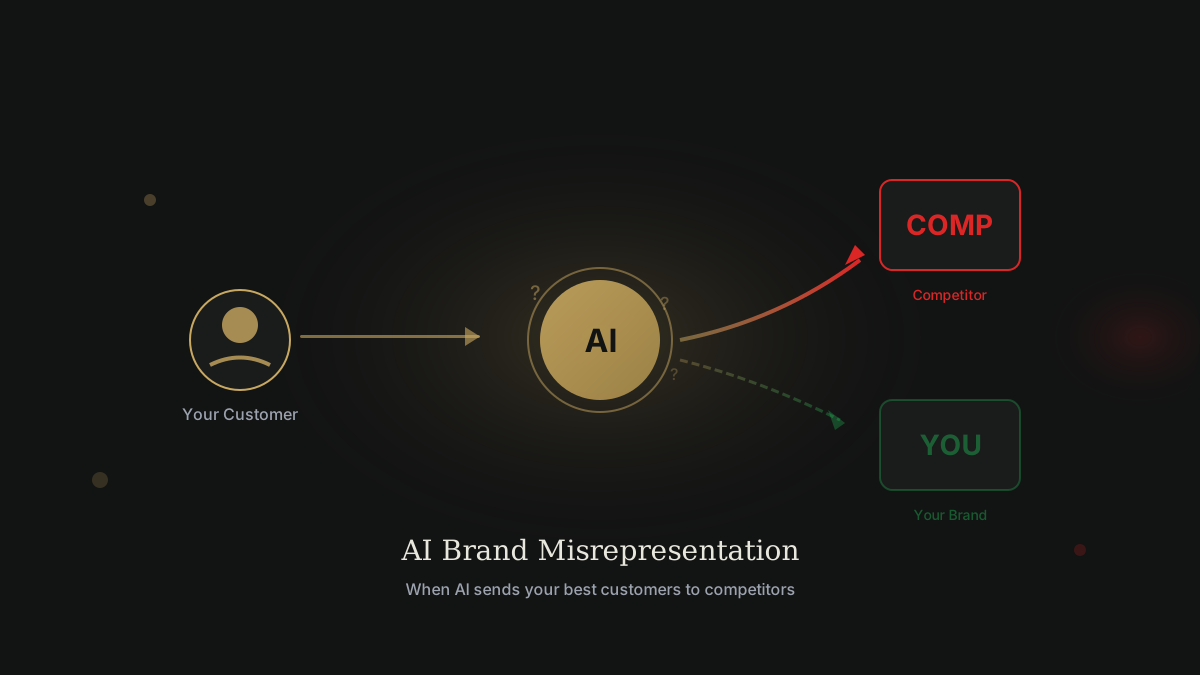
A prospect asks ChatGPT about your product. Or they Google you and get an AI-generated answer at the top of the results. Either way, the AI confidently describes what you do, who you serve, and how you compare to competitors.
Except it gets key information, primed to influence purchasing decisions, wrong.
Maybe it says you’re enterprise-only when you serve startups, or it lists a feature you deprecated two years ago. It may even recommend a competitor for a use case you actually own.
And you had no idea this was happening.
This is AI brand misrepresentation, and it’s happening to most companies right now. The difference between AI misrepresentation and a bad Google ranking is that you never see the damage. There’s no bounce, low-converting visit, or data point in your analytics. The buyer simply never reaches your site because AI already told them you’re not the right fit.
The Importance of AI Visibility
AI assistants are describing your brand to hundreds of millions of users right now. ChatGPT alone has over 800 million weekly active users. Add models like Meta AI and Grok, which are built into social platforms and communication apps like Instagram, X, Messenger, Facebook, and WhatsApp. Now add in Google’s AI Overviews (AIO) appearing at the top of your search results, and a soon-to-come partnership, bringing Gemini to Siri, and you’re looking at a significant portion of your potential customers getting answers before they ever click a link.
When someone asks “What’s the best project management tool for remote teams?” or “Which CRM works for early-stage startups?”, AI doesn’t return a list of links. It gives a direct answer with specific recommendations. And if your brand isn’t mentioned, or is mentioned incorrectly, you’ve lost that prospect before the conversation even begins.
And yet, just 16% of brands systematically track AI search performance, according to McKinsey’s 2025 survey. That means 84% of companies have no idea what AI is telling prospects about them.
How AI Can Get Your Brand Wrong
AI misrepresentation shows up in predictable patterns. There are four categories where AI most commonly gets brands wrong:
Product Descriptions
AI often describes products using outdated information or conflates features from competitors. A SaaS company might find an AI model describing a feature they sunset eighteen months ago, or attributing a competitor’s capability to their product. This is simply what happens when AI synthesizes information from across the web without understanding what’s current.
Competitive Positioning
AI loves to make comparisons. But those comparisons are often based on outdated competitive analyses, biased reviews, or incomplete information. A brand might find AI recommending competitors for use cases they actually own, or positioning them as the budget option when they compete on value, not price.
Outdated Information
Your brand six months ago is probably not the same as your brand today. Products change constantly: pricing updates, features get added and removed, positioning shifts. But AI models have training cutoffs, and they supplement that training with web content that may be years old. So AI ends up confidently stating things about your brand that haven’t been true for months or even years.
Target Audience
This is a particularly costly error. AI frequently misidentifies who a product serves. An SMB-focused tool gets labeled as “enterprise-only,” a developer platform gets described as “no-code,” or a B2B service gets recommended for consumer use cases. When AI tells a prospect you don’t serve their segment (or their budget), they move on without ever checking if that’s true.
Why AI Gets Your Brand Wrong
Here’s what most founders don’t realize: AI understands your brand from a mixture of first-party content and third-party validation, but third-party consensus carries more weight in how AI ranks and summarizes information.
Your homepage, product pages, and blog posts still matter because they establish the baseline for how you want AI to understand your brand. But when your own website is the only source backing up those claims, that’s not a strong signal.
AI looks for external confirmation: coverage from reputable publications, mentions in analyst reports, inclusion on authoritative comparison sites, and discussions in industry forums and community discussions. If your brand isn’t present in these sources, AI has nothing to work with. And if your brand is there but the information displayed is outdated or incorrect, that’s what it learns and repeats to your prospects.
The combination of optimized first-party content and credible third-party validation is what shapes the answer. When the two align, AI gets your brand right, and when they don’t, AI defaults to the external narrative, if there is one.
How Much AI Misrepresentation Costs
Traditional marketing metrics don’t fully capture this problem. You can’t see the prospects who never clicked through, measure the deals lost to AI-driven misperceptions, or find an “AI told them we were enterprise-only” attribution in your CRM.
But the cost shows up in the pipeline.
Consider a typical buyer journey today. A CRO at a Series B startup needs a CRM that works for lean teams. Instead of Googling and clicking through ten results, they ask Gemini: “What’s the best CRM for early-stage startups?”
If AI doesn’t mention you, you’re invisible. If AI mentions you but says you’re “best for enterprise sales teams with 50+ reps,” you just lost a qualified prospect who would have been a perfect fit.
This happens hundreds or thousands of times before a single lead reaches your pipeline. And because you never see it, you attribute slow growth to other factors: bad messaging, poor targeting, not enough ad spend. Meanwhile, AI is quietly steering your ideal customers toward competitors.
If even 10% of your potential customers are now asking AI for recommendations, and AI is getting your brand wrong half the time, you’re losing 5% of your addressable market to invisible misrepresentation. For most growth-stage companies, that’s millions in unrealized revenue.
How to Find Out What AI Says About You
Before you can fix the problem, you need to understand it. Here’s a manual approach you can start with today:
Step 1: Identify Your Priority Queries
List 20-30 questions your ideal customers might ask AI. Think about category queries like “What’s the best [your category]?” and use case queries like “How do I [solve problem you solve]?” Include comparison queries such as “How does [your brand] compare to [competitor]?” and audience queries like “What [your category] works for [your target segment]?”
Step 2: Test Across Multiple Models And Document What You Find
Different models have different training data and different perspectives on your brand. Run your queries through ChatGPT, Claude, Gemini, Perplexity, and Grok. You’ll often find that one model gets your brand right while another gets it completely wrong.
And for each query, record whether you’re mentioned at all, whether the description is accurate, what’s wrong or outdated, who else is mentioned, and what sources the AI cites, if any.
This creates a baseline you can measure against as you work to correct misrepresentations.
Step 3: Identify Patterns
After testing, you’ll likely see patterns emerge. Maybe AI consistently gets your pricing model wrong, thinks you’re in a different category entirely, or recommends you for the wrong use cases. These patterns tell you where to focus your correction efforts.
Once you know what AI is getting wrong, the next step is fixing it.
How to Fix AI Brand Misrepresentation
Fixing AI misrepresentation requires work on two fronts: onsite optimization and offsite citations. Most brands focus on the first and ignore the second, which is a mistake.
Onsite Optimization
Start by making sure your own content is structured for AI consumption. Don’t rely on clever copywriting; use clear, unambiguous product descriptions that state plainly what you do, who you serve, and how you’re different.
From there, add structured data and schema markup to help AI understand the relationships between your content. Product schemas, FAQ schemas, and organization schemas all help AI extract accurate information. Keep everything updated: if a feature changed, update every page that mentions it. AI can’t tell the difference between your current homepage and a two-year-old blog post that describes deprecated functionality.
And be explicit about your audience. Don’t make AI infer who you serve. State it clearly: “Built for growth-stage startups” or “Designed for marketing teams at Series A through Series C companies.” The clearer you are on your own site, the less room AI has to fill in the blanks incorrectly.
Offsite Citations
This is where most brands fall short, and where the real opportunity exists.
AI models don’t trust what you say about yourself. They trust what authoritative third-party sources say about you. That means fixing AI misrepresentation requires getting accurate information published on the sources AI actually references.
This includes:
- Industry publications and trade media
- Review platforms and comparison sites
- News coverage and press mentions
- Research reports and analyst coverage
- Community sites and professional forums
When a reputable site describes your product accurately, AI pays attention. An industry analyst including you in a report with correct positioning shapes AI’s understanding, and a credible comparison site listing your actual features and target audience gets incorporated into its recommendations.
Why Offsite Matters More Than Onsite
Most brands focus their efforts on what they can control. But onsite optimization alone won’t fix AI misrepresentation.
You can perfect your website, add every schema markup, and make your positioning crystal clear on every page. And AI might still get you wrong.
Why? Because AI is designed to be skeptical of first-party claims. When a brand says “we’re the best,” AI discounts that. When authoritative third-party sources say “they’re the best for this use case,” AI incorporates that into its recommendations.
Think about how humans evaluate credibility. If a company claims to be innovative, you’re skeptical. If the Wall Street Journal calls them innovative, you’re more inclined to believe it. AI works the same way.
This is why the brands winning in AI visibility are investing heavily in offsite presence. They’re securing media placements that describe their products accurately, getting included in authoritative comparison content, earning coverage in the industry publications their buyers trust, and building citations in the research and analysis that AI models actually reference when forming recommendations.
Onsite optimization is necessary but not sufficient. Offsite citations are what actually shift AI’s perception of your brand.
How Lectern Helps You Close the Gap
Most companies, even after realizing how much AI misrepresentation matters, get stuck between knowing and solving. They know they need to fix their onsite content, but they’re not sure what to prioritize. They know offsite citations matter, but they don’t have relationships with publishers or time to pitch media. They can see the gap, but they can’t close it.
This is exactly where Lectern enters the picture.
Lectern is a content intelligence agent that tracks how AI represents your brand across ChatGPT, Claude, Gemini, Perplexity, Meta AI, and Grok. It identifies where AI gets it wrong, what information is missing, and which sources AI references when forming its understanding.
But tracking isn’t enough to solve the problem. Traditional tools in this space can show you what’s wrong, but they can’t fix it. They hand you a report and leave the execution to you, which means more recommendations to interpret, more tasks on your plate, and more work piling up.
Lectern works differently. Through a publishing network spanning 1,500+ credible outlets, including TechCrunch, VentureBeat, Architectural Digest, and USA Today, the agent handles content creation, optimization, and guaranteed placement on the sources AI actually trusts. It’s one of the most cost-effective ways to acquire offsite content without agency retainers or months of outreach.
The process is straightforward. You provide basic information about your company and industry, and receive an AI audit in return. From there, Lectern builds a visibility strategy, drafts optimized content, and coordinates placement on the outlets that AI models trust. You don’t need to hire an agency, pitch journalists, or figure out which outlets matter. Throughout the day, your inbox fills with progress instead of tasks. You approve the direction, and the agent does the rest.
That’s the difference. Other tools show you the gap. Lectern closes it through automated execution, without added headcount or busywork.
Frequently Asked Questions
How do I know if AI is getting my brand wrong?
Test manually by asking ChatGPT, Claude, Gemini, and Perplexity questions your ideal customers would ask. Compare AI’s responses to your actual positioning, features, and target audience. Or use Lectern to automate monitoring and handle the fixes.
Can I fix AI misrepresentation by updating my website?
Partially. Onsite optimization helps, but AI primarily learns about your brand via pattern recognition across both first- and third-party sources it considers authoritative. Fixing AI misrepresentation requires both onsite updates and offsite citations on trusted publications.
How long does it take to correct AI’s perception of my brand?
It depends on the severity of the misrepresentation and your current offsite presence. Brands typically see initial improvements within 1-3 months of consistent content optimization and media placement. Significant shifts in AI perception usually take 3-6 months.
Which AI models should I prioritize?
Focus on the models your customers actually use. For B2B SaaS, prioritize ChatGPT, Claude, and Grok if your audience is active on X. For consumer products, add Meta AI, Gemini, and Perplexity. All brands should be focused on Google’s AI Overviews. Lectern helps you identify which models matter most for your specific customer base.
What sources do AI models trust most?
AI models weigh authoritative third-party sources heavily: major news publications, industry-specific media, established review platforms, academic and research institutions, and recognized industry analysts. First-party content (your own website) carries less weight.
How is this different from SEO?
SEO optimizes for Google rankings, while AEO (Answer Engine Optimization) optimizes for AI recommendations. The strategies overlap but aren’t identical. AEO requires more comprehensive content, stronger emphasis on third-party citations, and explicit positioning that AI can parse and repeat accurately.
AI is describing your brand to millions of potential customers right now. The question is whether it’s getting the story right. Start your Lectern visibility check and find out what AI really says about you.
Take Back Your Brand’s Narrative
Misnamed products, outdated descriptions, and competitor recommendations are shaping how potential customers see you before you ever get a chance to make your case. Most brands don’t know it’s happening, and the ones that do often don’t know where to start.
Lectern shows you the gap and closes it. It tracks how AI represents your brand, identifies where it’s getting you wrong, and automatically handles the execution, from content optimization to cost-effective, guaranteed placement across 1,500+ credible outlets.
Ready to find out what AI really says about you? Start your Lectern visibility check and begin fixing it today.
Written by

Rodrigo Murguia
Content WriterRodrigo is a content writer based in Buenos Aires, Argentina. With bylines in Village Voice and LA Weekly, he helps brands and professionals tell their story. Driven by a passion for amplifying fresh perspectives and giving voice to new ideas.